
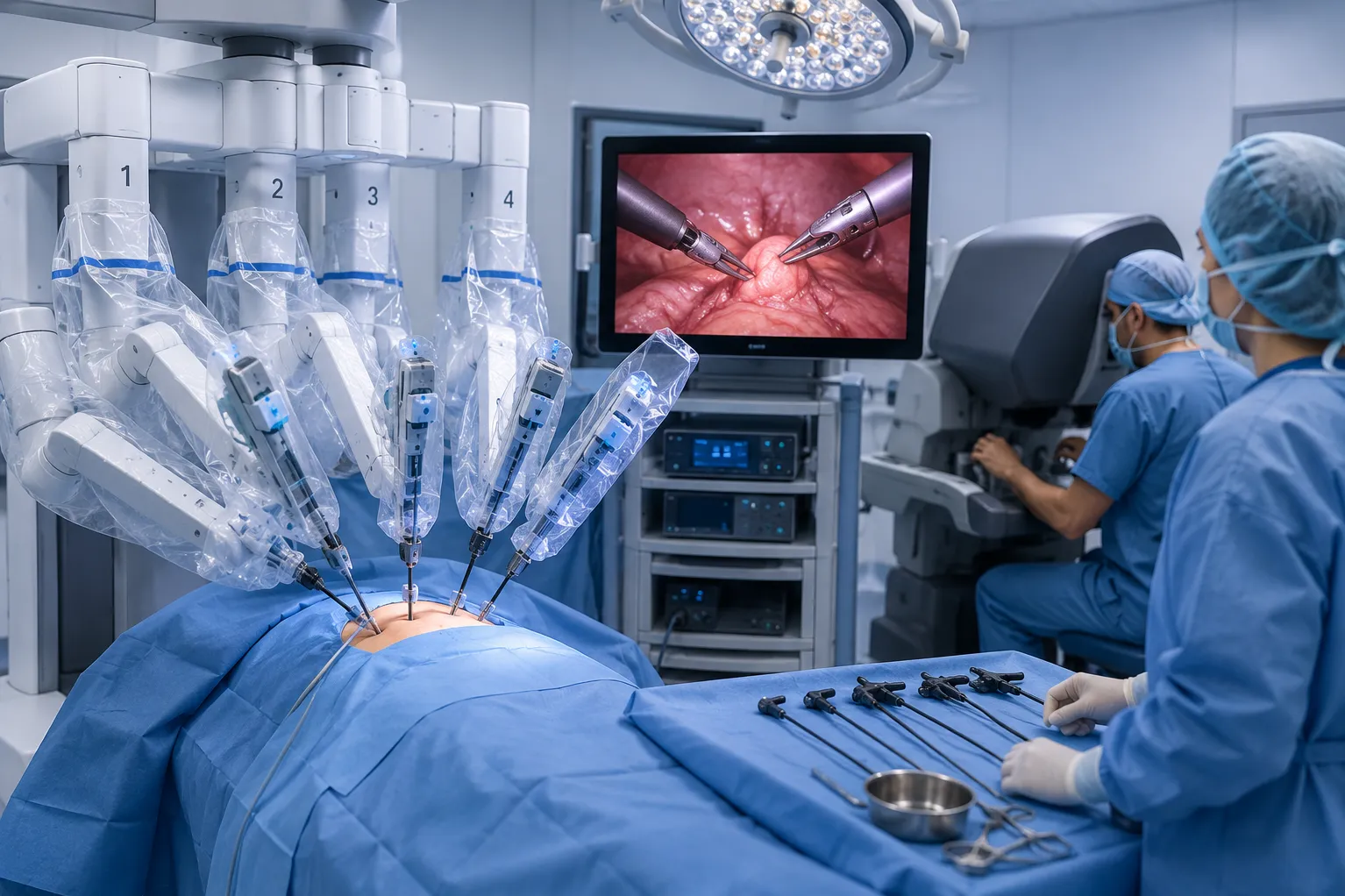
Robotic and laparoscopic surgery are both minimally invasive approaches used for selected gynecological procedures. Because both typically involve small incisions, patients sometimes assume they are essentially identical or that robotic surgery operates independently.
Neither assumption is quite accurate.
For women evaluating robotic gynecologic surgery in Pune, understanding how the two approaches differ can make conversations about surgical planning more meaningful.
What Happens During Laparoscopic Surgery?
In conventional laparoscopy, the surgeon introduces a camera and surgical instruments through small abdominal incisions.
The surgeon directly controls the laparoscopic instruments while viewing the operative field on a monitor.
Laparoscopy is used for a broad range of gynecological procedures, including selected hysterectomies, ovarian cyst surgery, fibroid surgery, and treatment of endometriosis.
How Is Robotic Surgery Different?
Robotic-assisted surgery also uses small incisions and a camera, but the surgical instruments are connected to a robotic system.
The surgeon operates the system from a console and remains in control throughout the procedure. The robot does not independently decide what to cut, remove, or repair.
Robotic systems can provide enhanced visualization and articulated instruments that allow complex movements within confined spaces.
Is Robotic Surgery Automatically Better?
Not necessarily.
Technology is one part of surgical decision-making. The diagnosis, complexity of surgery, patient's previous operations, anatomy, available equipment, and surgeon's experience with the chosen technique all matter.
Some operations can be effectively performed using conventional laparoscopy. For certain technically complex procedures, robotic assistance may provide useful operative capabilities.
The appropriate choice therefore needs to be individualized.
Comparing the Two Approaches
Both techniques aim to avoid a large abdominal incision when minimally invasive surgery is suitable.
Patients evaluating their options should focus on questions such as:
- Is minimally invasive surgery appropriate for my diagnosis?
- Why is laparoscopy or robotic assistance being recommended?
- How frequently does the surgeon perform this type of procedure?
- What are the alternatives?
- Could open surgery become necessary?
- What recovery should I realistically expect?
- How could the operation affect fertility or ovarian function?
These questions are usually more valuable than choosing an operation based solely on the word 'robotic.'
Which Conditions May Be Considered?
Robotic-assisted techniques may be used in selected cases involving hysterectomy, fibroids, endometriosis, and other gynecological conditions.
Suitability is not determined by diagnosis alone.
For example, two women with fibroids may have completely different surgical plans because the number, size, and position of their fibroids differ. Previous abdominal operations, body anatomy, reproductive goals, and other conditions can further influence the decision.
What About Recovery?
Both laparoscopic and robotic procedures are minimally invasive, but recovery is determined substantially by what was done internally.
A patient undergoing a relatively limited procedure cannot reasonably compare her recovery with someone undergoing extensive adhesiolysis or complex endometriosis surgery simply because both operations used small incisions.
Hospital stay, pain management, activity restrictions, and return to normal routines should therefore be discussed according to the actual operation.
Choosing Based on the Procedure, Not the Technology
Patients in Pune and other parts of Maharashtra increasingly encounter references to robotic surgery while researching gynecological treatment.
The technology can be valuable, but the decision should remain diagnosis-driven.
Dr Kunaal Shinde, Best Gynecologist provides minimally invasive gynecologic surgical evaluation, including consideration of laparoscopic and robotic approaches where clinically appropriate.
A useful surgical consultation should explain why a particular approach fits the patient's condition. When that reasoning is clear, patients can compare options based on clinical relevance rather than assuming that newer technology automatically means a better choice.
Keywords